
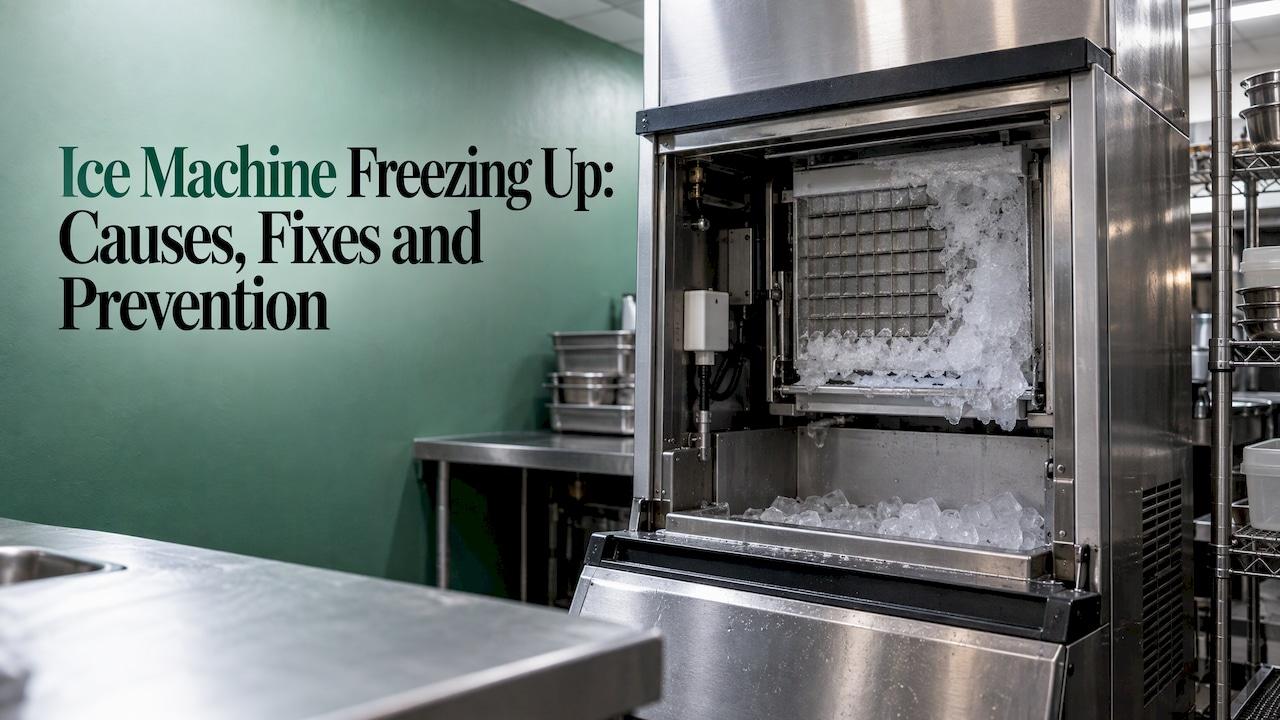
A commercial ice machine freezes up when ice keeps building on the evaporator instead of releasing during harvest. The fix depends on why the harvest failed. Usually it is one of four things: a water-side problem such as scale or low flow, a control fault such as a dirty or misadjusted thickness probe or a bad float switch, a harvest-heat fault, or a refrigeration issue. This guide shows how to confirm which one you have, how to thaw the machine safely, which parts are the usual suspects, and when to hand the job to a qualified technician.
TL;DR
- A true freeze-up means ice bridges across the evaporator and locks into a solid block. Frost on a water line or cubes stuck together in the bin is a different fault.
- Switch off the power and water and let the block melt. Never chip ice with a screwdriver or any sharp tool.
- The most common culprits are scale, low water flow, dirty or faulty probes and float switches, failed harvest heat, and poor installation or airflow.
- Replace a part only after you have confirmed the fault. Refrigerant work, compressor diagnosis and electrical measurement belong to a certified technician.
- A fixed cleaning schedule, a clean condenser and filtered water prevent most repeat freeze-ups.
Table of Contents
- What a freeze-up actually looks like
- Why the evaporator freezes up
- Thaw the machine safely first
- A step-by-step diagnosis you can do in-house
- Which parts are likely involved
- When to call a qualified technician
- Preventing repeat freeze-ups
- Our perspective on keeping ice machines running
- Get the right part without the delay
- FAQ
- Sources
What a freeze-up actually looks like
People say "my ice machine is freezing up" about several different problems. Separating them first saves a lot of time and money.
A true evaporator freeze-up is when ice keeps growing instead of releasing at harvest. According to one field guide, it bridges to frames, distribution tubes or shrouds until the unit is a solid block. Typical signs:
- A continuous mass of ice covering the evaporator.
- Frozen fingers of ice where the water spray hit and refroze.
- Long freeze cycles, harvest timeouts or repeated long-freeze or long-harvest fault codes.
The other things people call a freeze-up are different faults:
- Cubes fused into one slab inside the bin. This points to bin temperature, melt and refreeze, or a bin control issue.
- Frost on a water line or on the bin walls.
- A refrigerant-circuit problem that happens to show up as ice in the wrong place.
Open the bin door and look before you touch anything. If the evaporator itself is clear and the ice is stuck in the bin, you are not dealing with a harvest failure.
How ice should form on a healthy machine
On a healthy cube machine, water recirculates over a cold evaporator plate until a control signals that the slab is thick enough. That control may be a thickness probe, a thermistor curve or a conductivity bridge. The machine then briefly warms the evaporator, usually with hot gas, so the slab releases. Then it resets for the next freeze.
The pattern matters too. ACHR News notes that water should freeze across the whole evaporator at the same time. Ice that starts at the bottom and creeps upward is not normal, and you should note it as a diagnostic sign.

Why the evaporator freezes up
Ice releases when the plate surface warms just enough to break adhesion. That needs enough harvest heat, a clean smooth surface, the right slab thickness and the right timing. If any one of these fails, adhesion wins and the ice stays put.
The causes fall into five groups.
Water-side problems
Scale on the evaporator makes the surface rough, so ice grips it harder. Low water flow, uneven distribution across the plate and a seeping inlet valve that overfills the sump all upset the freeze. Hoshizaki's freeze-up service bulletin lists low water flow during harvest and dirty evaporators among the common causes. It also notes that freeze-ups can take several days to build, so a technician often sees only the end result.
Control and sensor faults
A dirty or misadjusted ice thickness probe can let the slab grow too thick or end the cycle at the wrong time. Thermistors that read out of spec, a board whose calibration is off, and a dirty or defective bin control or float switch have the same effect. Ice that is too thick for the harvest to release is the classic result.
Harvest heat failures
If the hot-gas valve does not energize, the hot-gas path is restricted, or the compressor cannot deliver enough flow, the evaporator never warms enough to let go. The hot-gas line may warm briefly during harvest while the ice stays stuck. That is a clue that heat is arriving but not enough of it.
Refrigeration issues
A low refrigerant charge, a restricted thermostatic expansion valve (TXV), a loose TXV bulb or a dirty condenser can all push the machine into a freeze-up. A pattern of ice at the bottom and thin or no ice at the top suggests a refrigerant-side fault rather than a simple harvest problem. That is technician territory.
Installation and environment
A machine that is not level, has poor ventilation around it, or runs with air or incoming water that is too cold will struggle to harvest. Kitchens with cramped, hot, greasy spaces behind the line also load the condenser faster, so airflow checks deserve a regular slot in your routine.
Thaw the machine safely first
Before you diagnose anything, the block has to melt. Do it the safe way.
- Cut power and shut off the water. Unplug the unit or isolate it at the breaker, and close the supply valve.
- Open the panels and protect the area. Put a tray or towels under the machine to catch meltwater.
- Let it thaw, or use warm water. Warm water over the ice is fine. Never chip with a screwdriver or any sharp tool. Field guidance is clear about this, and chipping can damage the evaporator or the refrigerant tubing.
- Check the drain. Make sure water flows away freely. A slow drain makes every other problem worse.
- Follow the manual's thawing procedure for your model if it gives one.
Discard any ice that was in the bin during the fault. Ice is a food product, so treat the machine's interior as a food-contact surface and sanitize it after cleaning.
A step-by-step diagnosis you can do in-house
Work through the machine in this order. The simple checks come first and each one rules something out.
Step 1: Reset the baseline
If you see scale, descale with a solution made for ice machines and safe for the evaporator's nickel plating. Follow the manufacturer's instructions for concentration, circulation time and rinsing. Then sanitize with a food-safe sanitizer at the correct strength. Run the first cycles after cleaning and discard that ice. A clean baseline means any freeze-up that returns is more likely to be a real fault than a dirty surface.
Step 2: Watch one full cycle with the panels off
Watch how the water falls across the evaporator. It should cover the plate evenly. Dry patches, uneven streams or water bypassing the plate point to a distribution or flow problem. Feel the hot-gas line at harvest if your manual allows you to do so safely. Note whether ice begins to form evenly across the whole plate or only at the bottom.
Step 3: Check the water supply
Hoshizaki's checklist for its own machines gives a good picture of what to verify. The sump should fill to overflow in 60 to 90 seconds or less when empty. The water line should be 1/2 inch, and the checklist gives target flow rates of 3 GPM for its KM-150 to KM-900 models and 5 GPM for the KM-1200 to KM-2400 models. Your machine's manual will list its own figures, so use those. A kinked line, a clogged filter or a half-open valve is a cheap fix compared with a part swap.
Step 4: Check the sensors and switches
The same checklist asks you to confirm that the float switch is clean, that the water pump is not running constantly during freeze, that the thermistor is mounted correctly, that the TXV bulb is tight and insulated, and that the thermostatic bin control shuts the unit off within 6 to 10 seconds when it touches ice. Those figures are for Hoshizaki's models, but the logic applies broadly: each sensor must be clean, correctly mounted and responding.
If a sensor is dirty, clean it first. If it is mounted loosely, remount it. A dirty probe is not a bad probe.
Step 5: Check the condenser and airflow
A clogged condenser or a weak fan motor reduces the machine's ability to reject heat, and that upsets the whole cycle. Clean the condenser, clear the space around the unit and confirm the fan spins freely. Make sure the machine is level.

Step 6: Stop at the refrigeration circuit
If all of the above checks out, the likely cause lies in refrigerant, the TXV, the hot-gas valve or the compressor. Those need gauges and certification. Manitowoc's refrigeration diagnostic procedure for its R290 (propane) machines recommends diagnosing by temperature first. It uses digital thermometers with insulated thermocouples on the suction line and discharge line, each within 4 inches of the compressor, and on the harvest valve, within 4 inches of its inlet. It calls for doing so with all doors and panels in place. That is not a job for guesswork.
Which parts are likely involved
Once a fault is confirmed, the part list is usually short. Match each symptom to a suspect, then verify before you buy.
| Symptom | Likely suspect | How to confirm first |
|---|---|---|
| Slab grows too thick, cycle runs long | Ice thickness control probe | Clean the probe and check its gap and mounting against the manual |
| Water level wrong, pump runs constantly or overfills | Float switch (ice thickness or harvest) | Clean it and check that it moves freely and signals correctly |
| Ice at the bottom, thin ice at the top | TXV bulb contact or insulation, refrigerant charge | Check bulb tightness and insulation; leave charge checks to a technician |
| Condenser hot, machine short on capacity | Fan motor, dirty condenser | Clean the coil and check that the fan turns freely |
| Compressor will not start or cycles on protection | Start protector, contactor | Have a technician measure voltage and continuity |
Our catalog includes parts for several of these situations. You can find an ice thickness control probe, an S-series thickness probe, an ice thickness float switch and a harvest float switch. We also list a TXV bulb insulation boot and a Manitowoc fan motor. Always check the part number against your machine's model and serial plate.
Confirm before you replace
A part is not faulty just because it sits near the symptom. Clean it, check its mounting and compare its behavior with what the manual says it should do. Hoshizaki's technical support team calls its freeze-up checklist one of its most important tools, because completing it can save you from thawing a second freeze-up that was never really fixed. The same habit works for you: write down what you checked and what you saw, even in a simple log. If the technician later has to come in, that list shortens the visit.
When to call a qualified technician
Some faults are not for operators. Stop and call a certified technician when the job involves:
- Refrigerant recovery, recharge or leak repair, which requires proper certification under the rules that apply where you work.
- Connecting manifold gauges to read refrigerant pressure.
- Diagnosing or replacing a compressor.
- Electrical diagnosis beyond a basic visual check, such as measuring voltage or tracing circuits.
- Any machine still under warranty, where unapproved repair can put the cover at risk.
- Repeated freeze-ups after you have cleaned, descaled and checked water flow.
An ice machine combines water, electricity, refrigeration and a food-contact surface. If you are unsure, do not guess. A small fault left alone can grow into an expensive breakdown.
Preventing repeat freeze-ups
Most freeze-ups are predictable, which means most are preventable. Build the following into your weekly and monthly routine.
Know your water
Test the water at the machine itself, not at the building's main supply. Scale is the usual slow cause, and its speed depends on your water's hardness. If your supply is hard, add sediment and carbon filtration plus hardness reduction, and set your descaling interval accordingly. Hard water needs descaling more often than soft water. Many maintenance guides suggest a range from monthly in very hard water to every few months in soft water, but your manufacturer's manual and your own inspection of the evaporator should set the real interval.
Also avoid the opposite extreme. Water with very little mineral content can confuse conductivity-based harvest controls, so very pure water is not always better. Ask your machine's manufacturer what water quality it recommends.
Keep the condenser and airflow clear
Clean the condenser on a regular schedule. In a busy kitchen, grease and dust load it faster than you expect. Keep a clear gap around the machine for ventilation, and check that it stays level after any cleaning or moving of equipment.
Replace filters on time
A clogged filter restricts flow, and low flow is a leading cause of freeze-ups. Put filter changes on the same calendar as cleaning, and date each new cartridge.
Clean and sanitize on a schedule
Cleaning removes scale and residue. Sanitizing is a separate step, and ice is food, so both matter. Follow the manual for your model and keep a written record. A log of cleaning dates, filter changes and any fault codes also helps if a service visit or an inspection is ever needed.
Watch for early warnings
Cloudy or misshaped cubes, falling production, longer cycles and noisy freeze phases all come before a lockup. Treat them as a signal to inspect, not as normal wear.
Our perspective on keeping ice machines running
In our experience supplying commercial kitchens across Saudi Arabia, the machines that give the least trouble are the ones where the operator treats a freeze-up as a symptom, not a verdict. A freeze-up has a cause, and the cause is almost always something small that was missed in the weeks before.
That is why we advise our customers to work in order: thaw safely, clean, check the water, then look at sensors and switches. Only then do we look at a part. When a thickness probe, float switch, TXV insulation boot or fan motor really is the fault, the right replacement matters. Our position is that original parts, made for the machine and the brand, are the best way to restore the cycle the manufacturer designed. The aim is for the machine to behave again as the manual describes.
For a restaurant or caterer, downtime means lost drinks, lost sales and lost goodwill. We built our catalog around brands such as Manitowoc so that kitchen managers can match a part number to a machine and order without a long search.
the author
Get the right part without the delay
When you have confirmed the fault, the next cost is waiting. We supply original spare parts for commercial kitchen equipment, including ice machine parts for Manitowoc and other international brands, to restaurants, caterers and food service operators in Saudi Arabia. Browse the Manitowoc and other brand catalogs, or see the wider range under other products.

Have your machine's model and serial number ready, and note the part number printed on the old component. That is the fastest route to a correct match, and it keeps your downtime short.
FAQ
Can I chip the ice off the evaporator to restart the machine faster?
No. Sharp tools can damage the evaporator or the refrigerant tubing, and that turns a simple fault into a major repair. Turn the machine off, close the water supply and let the ice melt, or follow the thawing procedure in your manual. If it freezes again, call a technician.
Why does the ice form at the bottom of the evaporator first?
Water should freeze across the whole evaporator at the same time. Ice that builds from the bottom upward is not normal. It can point to a refrigerant-side problem, such as a low charge or a restricted TXV, or to a water distribution issue. Refrigerant checks need a certified technician.
Is a dirty thickness probe the same as a faulty one?
Not necessarily. Scale or residue on a probe can make the machine misjudge slab thickness, and cleaning it may solve the problem. Replace the probe only if it is still wrong after cleaning, correct mounting and a check against the manual's specification.
How often should I descale my commercial ice machine?
It depends on your water hardness and your manufacturer's instructions. Harder water needs more frequent descaling. Test the water at the machine, inspect the evaporator regularly and adjust the interval to what you actually see. Sanitize after every descaling.
When is a freeze-up a job for a technician?
Call one if the fault involves refrigerant, gauges, the compressor or electrical measurement, if the machine is under warranty, or if freeze-ups keep returning after cleaning and water checks.
Sources
- Hoshizaki SB03-0003 Freeze Up Check List
- Six Steps For Ice Maker Diagnostics, ACHR News
- Manitowoc refrigeration diagnostic procedure for R290 machines
- Evaporator freeze-ups: ice machine freezing over, a field guide